Networking fundamentals / 01
Networks, OSI, and TCP/IP
Introduce networks and protocols, walk through the seven OSI layers, and map them to TCP/IP.
On this page
What is a network?
The original introduction breaks “network” into “net” and “work”: a web of things working together. Applied to communications, it describes connected devices exchanging data with one another.
What is a protocol?
A protocol is an agreed set of communication rules. It lets computers, or a central computer and its terminals, exchange information in a meaningful way.
Three aspects are introduced here:
- Syntax: which parts of the transmitted data contain which information.
- Semantics: what those parts mean according to predefined rules.
- Timing: which data is sent and how quickly it is sent.
The seven OSI layers
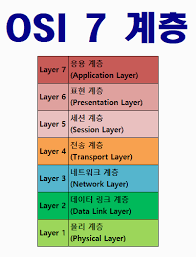
The OSI model divides network communication into seven layers. Layering helps separate responsibilities, making changes, additions, and maintenance easier to reason about.
- Physical: electrical and physical details needed to connect devices and transmit signals. The lesson gives hubs and repeaters as examples.
- Data link: transferring data between neighboring entities and providing link-level procedures such as error detection.
- Network: finding paths across intermediate nodes. The original overview includes routing, fragmentation, and network-level control among its responsibilities.
- Transport: end-to-end communication services. Depending on the protocol, these can include reliability and control over delivery.
- Session: managing communication sessions between applications.
- Presentation: translating data representations; the model associates encoding, compression, and encryption with this layer.
- Application: services through which applications exchange information.
Editorial clarification: the original overview attributes reliability to the transport layer in general and describes OSI sessions as “TCP/IP sessions.” Not every transport protocol guarantees delivery, and the OSI and TCP/IP models are not identical. These are conceptual layers, not a requirement that every real protocol stack implement seven separate components.
Mapping to TCP/IP
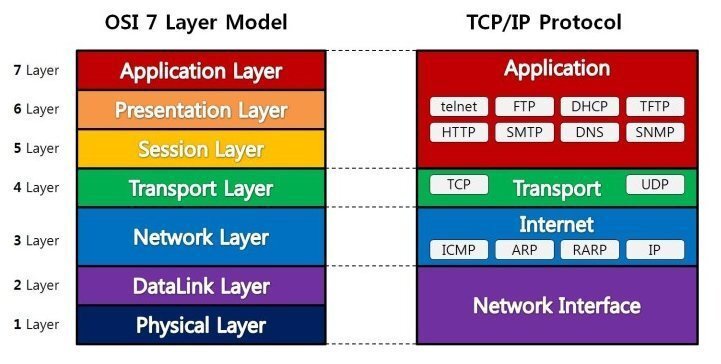
The four-layer TCP/IP model maps to OSI as follows:
| TCP/IP layer | Corresponding OSI layers |
|---|---|
| Application | Application, Presentation, Session |
| Transport | Transport |
| Internet | Network |
| Network interface | Data link, Physical |
The diagram lists application protocols including HTTP, FTP, SMTP, DNS, DHCP, TFTP, Telnet, and SNMP, and shows TCP and UDP at the transport layer. It also places ICMP, ARP, RARP, and IP around the Internet layer; the classification of link-adjacent protocols such as ARP varies by model.
The original final sentence refers to the top TCP/IP application layer mapping to OSI's top three layers, not all four TCP/IP layers mapping to those three alone.
Moved here from Tistory
I migrated this post from my Korean Tistory blog, I am Jason Lee, to this website and translated it into English. My writing and projects now live together in one place.
The original publication date, code examples, and screenshots are preserved. Editorial notes clarify known issues in the original material.
Original post on Tistory English edition · Aug 30, 2026